UTB Envirotec 30-year anniversary logo

Contact

Solutions

Wastewater Treatment

Wastewater treated to discharge or reuse standards on processes we developed ourselves, for every plant from city hall to factory floor.

Every plant begins with the same question: what has to come out of the water, and how tightly. We design to the discharge limits on total nitrogen, total phosphorus, COD and suspended solids, and build the process that meets them at the lowest lifetime cost in energy, chemicals, sludge and CO₂, whether that is one continuously fed reactor for a town or a membrane plant inside a factory fence.

Four proprietary processes cover the range. CYCLATOR™ carries oxidation, nitrification and separation in a single- or multi-basin layout with the inflow never stopping. BIODEC™ decants it on one moving part. HYBRATOR™ adds biofilm carriers where the load swings or the footprint is fixed. MEMBRATOR™ closes the outlet with membranes when the effluent has to be clean enough to put back to work.

These are UTB's own installations rather than licensed designs: 63 CYCLATOR plants since 2006 and 75 BIODEC decanter installations across 10 countries.
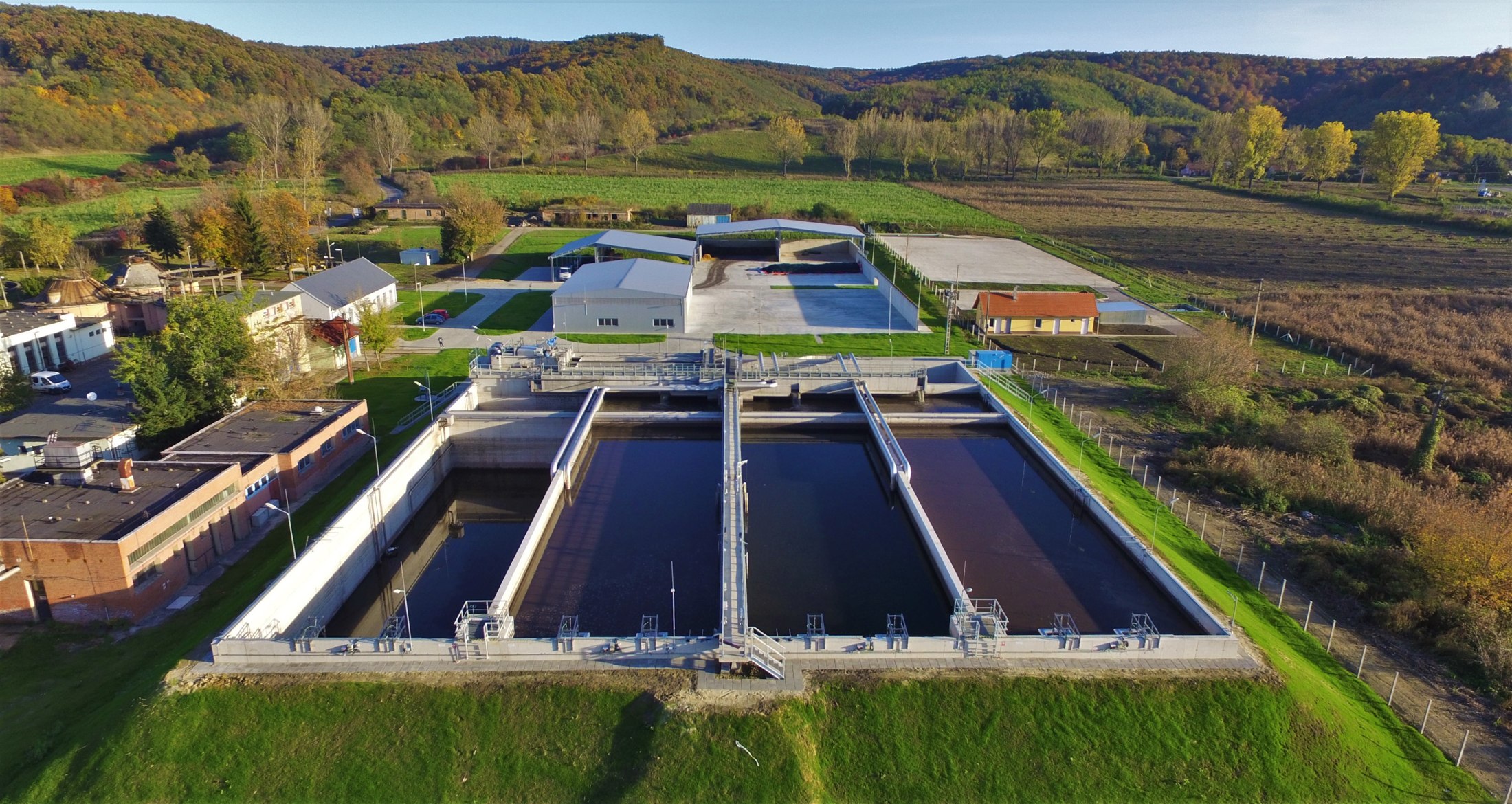
Aerial view of the Ózd municipal wastewater treatment plant, Hungary
Ózd regional wastewater works, Hungary: a UTB biological line in service

What it covers

Municipal

  • Towns and regional agglomerations
  • Septic waste co-treatment
  • Upgrading existing plants without new tanks

Industrial

  • Food and beverage effluent
  • High-load organic streams
  • Streams prone to filamentous growth

Tight outlets

  • Tight limits on total nitrogen and phosphorus
  • Process water recovery
  • Small works with strict limits

UTB advantages

  1. 01
    The processes are ours

    CYCLATOR, BIODEC, HYBRATOR and MEMBRATOR are our own processes, not licensed packages, so the design follows your discharge limits rather than a supplier's standard catalogue.

  2. 02
    Proven on your own water first

    Bench and pilot trials run on your actual effluent before anything is sized, so the guarantee rests on measured data rather than assumption.

  3. 03
    One contract from design to commissioning

    We carry the process design, engineering, procurement and construction under a single turnkey responsibility: one company to hold to the result.

  4. 04
    A reference list, not a prototype

    63 CYCLATOR plants since 2006 and 75 BIODEC decanter installations across 10 countries, all built and commissioned by UTB.

Frequently asked questions

A sewage treatment plant (STP) treats municipal wastewater from homes and businesses, while an effluent treatment plant (ETP) treats industrial process water, which is usually stronger, warmer and more variable. We design and build both, often on the same site, where a factory's effluent is pre-treated before it joins a municipal stream. In India, capacity is usually given in MLD (million litres per day): 1 MLD equals 1,000 m³/day.

A continuous-flow SBR keeps taking inflow while it settles and decants, so it needs no equalisation tank or extra basins; a conventional SBR works in batches and needs both. Our CYCLATOR runs nitrification, denitrification and biological phosphorus removal in one basin on a 288-minute cycle. 63 CYCLATOR plants have been delivered since 2006, including Kiskunhalas at 4,290 m³/day.

A membrane bioreactor (MBR) is the right choice when effluent must meet reuse or tertiary quality, space is tight or discharge limits are strict. Ultrafiltration membranes replace the clarifier and tertiary filters, so the reactor runs at 15–25 g/L MLSS and delivers suspended solids below 10 mg/L. MEMBRATOR treats 600 m³/day of antibiotics effluent at Xellia Pharmaceuticals in Budapest.

Yes: many plants can take more load or meet tighter nitrogen and phosphorus limits without new civil works. Adding biofilm carriers to an existing basin, as HYBRATOR does, raises its capacity, and converting to continuous-flow SBR operation adds nutrient removal in the same tanks. Every upgrade starts with a process audit of what the plant can achieve today.

The biggest savings come from designing the biology first, because aeration is usually a plant's largest energy cost and sludge disposal its largest operating cost after that. Controlled aeration, biological rather than chemical phosphorus removal and the right process conditions reduce sludge production and nitrous oxide (N₂O) emissions, the largest part of a plant's carbon footprint. The sludge that remains goes to digestion and energy recovery instead of disposal.

Every plant is handed over with operator training, and our support continues afterwards. We provide process audits, troubleshooting, online monitoring and upgrade studies, and under Build-Own-Operate (BOO) contracts we run operation and maintenance ourselves. Our EPC and turnkey service covers the whole route from design to handover.

Yes: alongside our European references, we design sewage treatment plants for cities and effluent treatment plants for industry in India and the Gulf. Plants are built to national standards such as India's Central Pollution Control Board (CPCB) norms, and for the water reuse that scarcity makes essential across the region. UTB has delivered 660+ plants in 41 countries since 1964; browse them in our reference list.

Send your flow rate, load and discharge limits.

An engineer will come back with an indicative process solution and a view on whether a pilot trial is worthwhile.

Request a technical assessment